How to Prevent Tooth Decay in Children?
Many people pay more attention to adult teeth as the adult teeth will accompany us throughout the majority of our lifespan. While this is true, it is also very important to pay special attention to our baby teeth.
Toddlers who are teething at this stage, are also starting to take in semi-solids and converting from liquid to solid food. Our baby teeth play a vital role here to chew well so that the food get digested properly, and absorb nutrients for growth.
What causes tooth decay?
Tooth decay happens to children as well as adults.
To understand more about what causes tooth decay, we need to know how a tooth structure is like and how it gets the destruction from external factors.
Tooth decay typically starts from the outer layer of the tooth (enamel). It is caused by bacteria and other things such as food that contains sugar that are left on the teeth. For a child, the most common ‘sugars’ are milk, sugary drinks, fruit juices, cereals and bread.
As our mouths naturally have bacteria, these bacteria will change the nature of the remnant of food trapped in between our teeth to produce acid. With the combination of bacteria, foo remnants, acid and our own saliva, a substance known as plaque is formed on our teeth. Over a period of time, the acid will corrode our tooth structure, mainly our enamel, resulting in tooth decay.
A child starts to change their baby teeth to adult teeth around 6 to 7 years old, the adult (permanent) teeth will accompany them for the rest of their life (a good 70 - 90% of their lifespan), it is very important to cultivate good oral hygiene. This starts from a proper habit to maintain their baby teeth healthy till the teeth-changing age.
Every tooth typically has 4 main parts
- Enamel - this is the outer layer (shell) of the tooth and it is also the hardest material in our human body
- Dentine - this is the second inner layer where the main part of the tooth is. It is the largest dental tissue
- Pulp - this is the soft tissue of the inner side of the tooth where nerves, and blood supply is. It has the ability to produce dentin.
- Root - this the important part of the tooth that helps to secure the tooth to our jaw
How does night milk causes tooth decay?
Milk contains high sugar contents. For children who have the habit of drinking milk in the middle of the night, they do not get the chance to rinse off the milk that remain in their mouths. In some cases, these children go to sleep with a milk bottle in their mouth, soaking their teeth in the milk throughout the night!
This is almost the same as sucking on a lollipop for a long period of time. We need a substantial time to dissolve a lollipop, that’s a lot of sugar-soaking time.
Symptoms of tooth decay in a child
These are some of the observations you may find when a child has tooth decay.
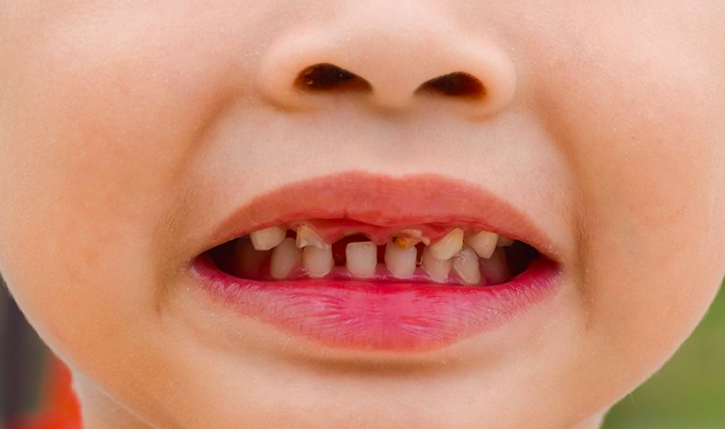
- White spots appearing on the tooth surface. These white spots are a good indication that the enamel layer is breaking down. It is an early sign of tooth decay.
- Discoloration of the affected area, tooth surface turning light brown
- The cavity has gotten deeper as the affected area turns darker in brown or even to black
- Sensitivity or pain reaction to temperature
The symptoms vary from child to child. Not every child will feel the same sensitivity, discomfort or react to the decay. Some children won’t even feel anything until their visit to the dentist. It is important to maintain good daily oral habits and routine dental checkups.
At Smile Design Dental Practice, we help you to monitor you and your child’s oral conditions. On every routine dental visit, our dentist will take intra-oral photographs to monitor the teeth conditions. Through the comparisons from these photos from previous and current visit, we can propose appropriate treatment for the child.

How do we prevent it?
We need to first establish proper oral hygiene, cleaning and adopt healthy oral habits. Prevention is always better than cure. We have also identified several common causes of tooth decay in a child.
For those children who already have early signs of tooth decay, parents have to identify the source of the problem, such as…
- Lack of proper brushing habits
- Falling asleep while drinking milk
- Drinking milk in the middle of the night (does not drink water to rinse off milk remnants)
- Daily diet - frequent consumption of juices and sugary drinks, candies and chocolate
Maintenance and prevention
- Cultivate good oral habits
- Avoid falling asleep with milk throughout the night
- Reduce consumption of sugary drinks, candies (especially lollipops) and chocolate
- Use cups instead of bottles to drink
- Go for regular dental checkup
We encourage all our patients including young children to maintain regular dental checkups. Dental issues can be easily picked up during the dental visits. It is better to solve dental issues while they are in the early stage, your child can possibly avoid feeling pain or discomfort and higher cost of treatments.
For more information and consultation, please contact Smile Design Dental Practice at +65 6463 8588.
To serve you better, we are available by Appointment Only.
Please contact us to schedule for an appointment.