Options to Replace Multiple Missing Teeth

Gordon Tam • January 8, 2026

Losing several teeth can affect more than just your appearance. It can impact chewing efficiency, speech, facial support, and overall oral health. Fortunately, modern dentistry offers several effective options to replace multiple missing teeth. The right solution depends on the number of missing teeth, bone condition, budget, lifestyle, and long-term goals.

Below is an overview of the most common tooth replacement options and what to consider for each.
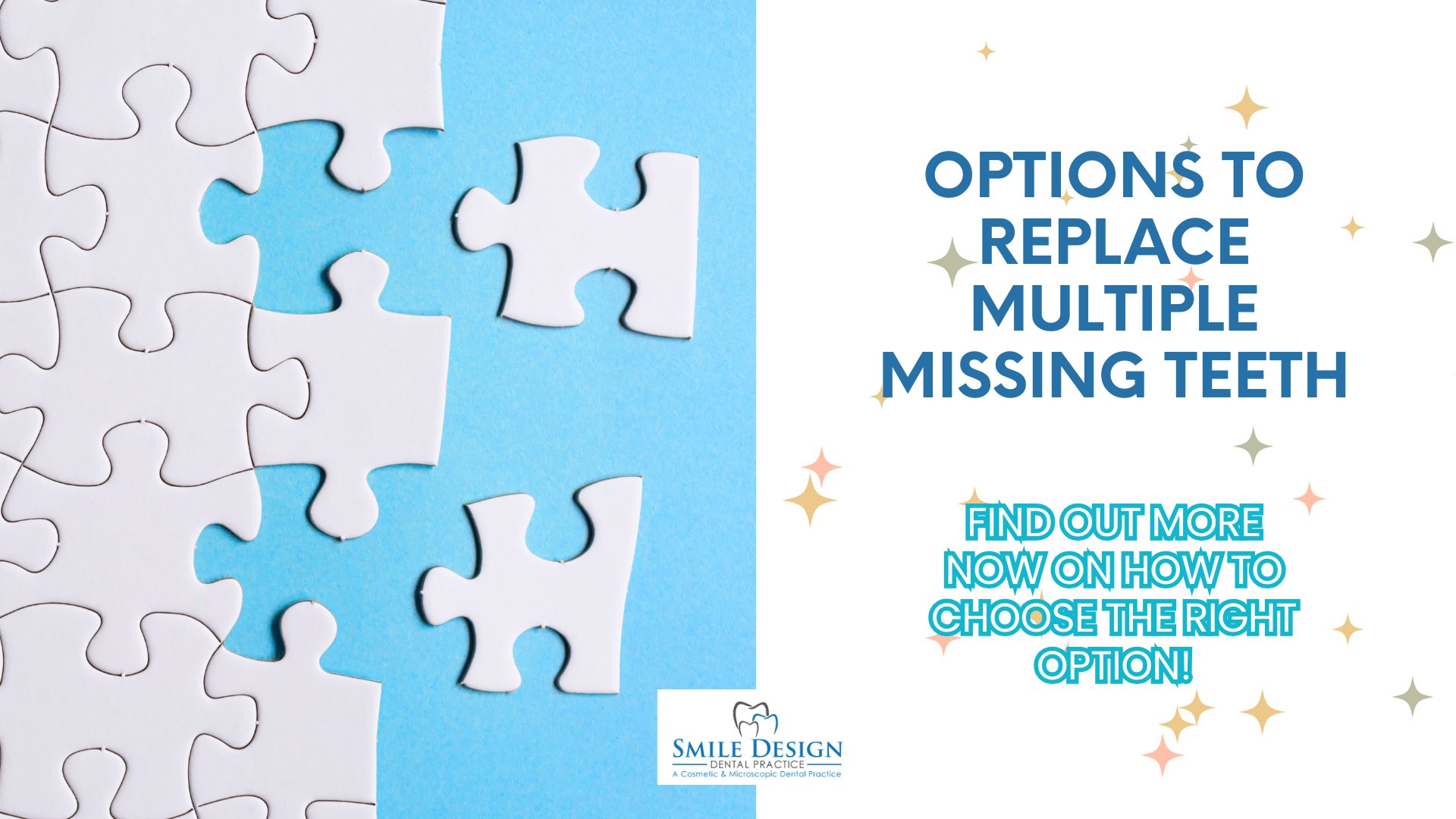
Why Replacing Missing Teeth Matters

When teeth are missing, the surrounding teeth may shift, the jawbone can gradually shrink, and bite problems may develop. Over time, this can lead to further tooth loss, facial collapse, and difficulties with eating and speaking. Replacing missing teeth helps maintain oral health, function, and confidence. 

1. Dental Implants (Implant-Supported Teeth)

Best for: Patients seeking a long-term, fixed solution that feels closest to natural teeth. 

Dental implants are titanium posts placed into the jawbone to replace tooth roots. They can support individual crowns, bridges, or full-arch restorations.

Options include:

  • Multiple individual implants for each missing tooth
  • Implant-supported bridges (fewer implants supporting several teeth)
  • Full-arch implant solutions (e.g. All-on-4 or All-on-6)

Advantages:

  • Do not rely on neighbouring teeth
  • Help preserve jawbone
  • Stable, comfortable, and natural-looking
  • Long-lasting with proper care

Considerations:

  • Higher upfront cost
  • Requires sufficient bone and healing time
  • Involves minor surgical procedures

2. Fixed Dental Bridges

Best for: Patients missing several teeth in a row with strong adjacent teeth. 

A dental bridge uses neighbouring teeth as anchors to support artificial teeth in between.

Advantages:

  • Fixed (not removable)
  • Shorter treatment time compared to implants
  • More affordable than implant solutions 

Considerations:

  • Adjacent teeth must be trimmed
  • Does not prevent bone loss in the missing tooth area
  • May need replacement over time 

3. Removable Partial Dentures

Best for: Patients seeking a non-surgical and cost-effective option.

Partial dentures replace multiple missing teeth and are removable for cleaning. Clasps or precision attachments may support them. 

Advantages:

  • Lower cost
  • Non-invasive
  • Easy to repair or adjust 

Considerations:

  • Less stable than fixed options
  • May feel bulky or uncomfortable initially
  • Requires daily removal and maintenance

4. Full Dentures (for Extensive Tooth Loss)

Best for: Patients missing most or all teeth in an arch.

Complete dentures replace all the teeth in an upper or lower arch and rest on the gums. 

Advantages:

  • Most economical solution for extensive tooth loss
  • No surgery required
  • Restores appearance and basic function 

Considerations:

  • Less chewing efficiency compared to implants
  • It can feel loose over time as the bone shrinks
  • May require adhesives and periodic relining

5. Implant-Retained Dentures

Best for: Patients who want improved denture stability without full fixed implants.

These dentures snap onto dental implants, combining the affordability of dentures with the stability of implants.

Advantages:

  • More secure than conventional dentures
  • Improved comfort and chewing ability
  • Less bone loss compared to traditional dentures

Considerations:

  • Still removable
  • More expensive than standard dentures
  • Requires implants and healing time

Choosing the Right Option

The best tooth replacement solution depends on:

  • Number and location of missing teeth
  • Bone health and gum condition
  • Budget and long-term expectations
  • Lifestyle and oral hygiene habits

A comprehensive dental assessment, including X-rays or 3D scans, is essential to determine the most suitable option.

Final Thoughts

Replacing multiple missing teeth is an investment in your health, function, and quality of life. With today’s advanced dental techniques, there is a solution for nearly every situation. Speaking with your dentist will help you understand your options and choose a treatment plan that suits your needs now and in the future.


Schedule an appointment with us NOW! Call us at 6463 8588 or WhatsApp to 9815 5336

To serve you better, we are available by
 Appointment Only

Please contact us to schedule an appointment.
By Gordon Tam January 3, 2026
Bruxism is a common but often overlooked condition that can quietly damage your teeth, jaw joints, and overall oral health. Many people are unaware they have it until significant symptoms appear. Understanding the facts about bruxism can help with early detection and effective management.
By Gordon Tam December 16, 2025
Fresh breath is more than just a social nicety—it’s essential to oral health and personal confidence. Whether you’re heading into a meeting, going on a date, or want to feel your best, maintaining fresh breath throughout the day requires a combination of good habits and awareness. Here’s everything you need to know about keeping your breath consistently fresh.
By Gordon Tam December 10, 2025
Gaps between teeth, medically known as diastema, are more than a cosmetic concern for many people. These spaces can trap food particles, increase gum disease risk, and affect oral health and self-confidence. Fortunately, modern dentistry offers several effective options to address these gaps, ranging from conservative approaches to more comprehensive treatments. 
By Gordon Tam November 28, 2025
Teeth grinding, clinically known as bruxism, affects millions of people worldwide. It often occurs unconsciously during sleep. This repetitive clenching and grinding can lead to significant dental damage and contribute to temporomandibular joint disorders (TMD). Fortunately, dental professionals have developed effective protective devices—night guards and occlusal splints—to combat these issues.
By Gordon Tam November 22, 2025
Waking up with a sore jaw, headaches, or sensitive teeth can be frustrating — and surprisingly common. One of the leading causes is teeth grinding and clenching, also known as bruxism, which often happens while you sleep.
By Gordon Tam November 10, 2025
Tooth decay is one of the most common dental problems among children — but the great news is, it’s almost entirely preventable. Building good dental habits early helps your child maintain a healthy, confident smile and prevents painful cavities and costly treatments later. Here’s what every parent should know to keep those little teeth strong and healthy.
By Gordon Tam November 5, 2025
Did you know that even baby teeth can get cavities? “Milk bottle caries,” also known as baby bottle tooth decay, is a common dental problem that affects many young children. It usually happens when babies fall asleep with a bottle of milk or sweetened drinks. The good news is — it’s completely preventable with the proper care and habits!
By Gordon Tam October 24, 2025
The Next Level of Teeth Whitening A radiant, confident smile starts with healthy, luminous teeth. While surface stains from coffee, tea, or ageing are common, not all whitening treatments are created equal. Microscopic dentistry takes professional teeth whitening to the next level — combining advanced technology with precision and enamel-safe care for remarkable results.
By Gordon Tam October 15, 2025
A radiant smile is more than just white teeth — it reflects precision, care, and health. Yet even with the best brushing habits, many people notice gradual discolouration that dulls their smile over time. At our clinic, we approach teeth discolouration through the lens of microscopic and aesthetic dentistry. We uncover the root cause of stains with magnified accuracy and offer targeted treatments for lasting brightness.
By Gordon Tam October 3, 2025
Modern crowns made from zirconia oxide look and feel like real teeth, with strength that lasts 10–15 years. At our clinic, crowns are often crafted and fitted on the same day, enhanced in our in-house lab for natural beauty. Using an operating microscope, we ensure a precise fit and a bite that feels just right. It’s not just a crown—it’s a long-term investment in your smile, comfort, and confidence. When it comes to restoring a damaged or weakened tooth, a dental crown is often the best long-term solution. But not all crowns are created equal. Advances in modern dentistry now allow patients to enjoy crowns that are stronger, more natural-looking, and fitted with precision. Here’s why choosing a high-quality dental crown is an investment in both health and confidence.
Show More