Why do I always wake up with aching jaws and stiff shoulders?
How do you know if you grind your teeth?

What is teeth grinding (bruxism)?
Teeth grinding is a condition where you excessively grind or clench your teeth. This usually occurs at night when you are sleeping.
Most of the time, you, as the ‘grinder’ or ‘clencher’ will not realise that you have this condition. Your sleeping partner will know. His or her sleep will be disrupted by the frequent and noisy sounds when you grind.
Do you wake up with aching jaws and stiff shoulders? You may even wake up with a headache! You seem to be ‘busy working’ through the night by grinding and clenching your teeth. With so many activities keeping you busy at night, you can’t help but feel tired in the day. You woke up feeling as tired as before you went to bed.
People with teeth grinding issues not only affect your daily lifestyle and concentration at work, but also the one sleeping beside you is affected too. Your partner can’t get the quality rest that they could with your teeth grinding sounds.
To improve this situation, we have to understand what causes teeth grinding and what the possible solutions are to it.
Causes of teeth grinding
- Stress and anxiety - Many people who lead a stressful lifestyle and working life, one of the ways to release stress is through grinding teeth during the night. This is a subconscious action that you won’t be aware of until the ‘damages’ of teeth grinding start to surface
- Sleep disorders such as sleep apnea - Studies have shown that patients with sleep disorders like sleep apnea are often associated with grinding their teeth
- Abnormal bite, misaligned or crooked teeth - Many who have misaligned teeth will over-stress some of the teeth during teeth grinding in the night. In order to correct this problem, at Smile Design Dental Practice, we may advise you to seek orthodontic treatments to have a better alignment of your teeth
What damages will it cause?
Many people questioned how bad teeth grinding can be. There is a range of mild to severe cases. Mild cases may be occasional grinders who only grind when you are stressed out during month-end, while chasing your sales quota, to severe habitual grinders who grind every other night!
The effects of the teeth grinding issue may not surface immediately, but gradually. And it will only deteriorate, especially if your tooth surfaces are starting to smooth and flatten, exposing the dentine layer and your teeth start to feel sensitive.
Some people wake up with a dull headache perpetually almost every day. Imagine how lousy you will feel to start a hectic day with a headache!
Consequences of teeth grinding:
- Wearing off (flattening) the surface of multiple teeth (shortening the teeth)
- Chipped, cracked tooth
- Loosen tooth structure
- Causes tooth sensitivity with the exposure of the dentin layer
- Gum recession
- Broken fillings
- Damage to the jaw joints
- Aching or tired jaws
- Soreness in the facial area, stiff neck, shoulder muscles aches
- Frequent headaches around the temple area
- Sleep disruption
Solutions
Many of our new patients report that they have teeth sensitivity and are unaware that they have a teeth grinding issue, which happens during their sleep.
We recommend that you come for a consultation to find out the cause(s) of your teeth grinding issue. At Smile Design Dental Practice, we offer a thorough tooth-by-tooth examination where we will also take photographs with our intraoral camera to document your oral conditions. From the photos, you will get to see what we see.
We can approach the dental issues better with an understanding of your oral condition. The intraoral photographs speak a thousand words.
Here are some solutions.
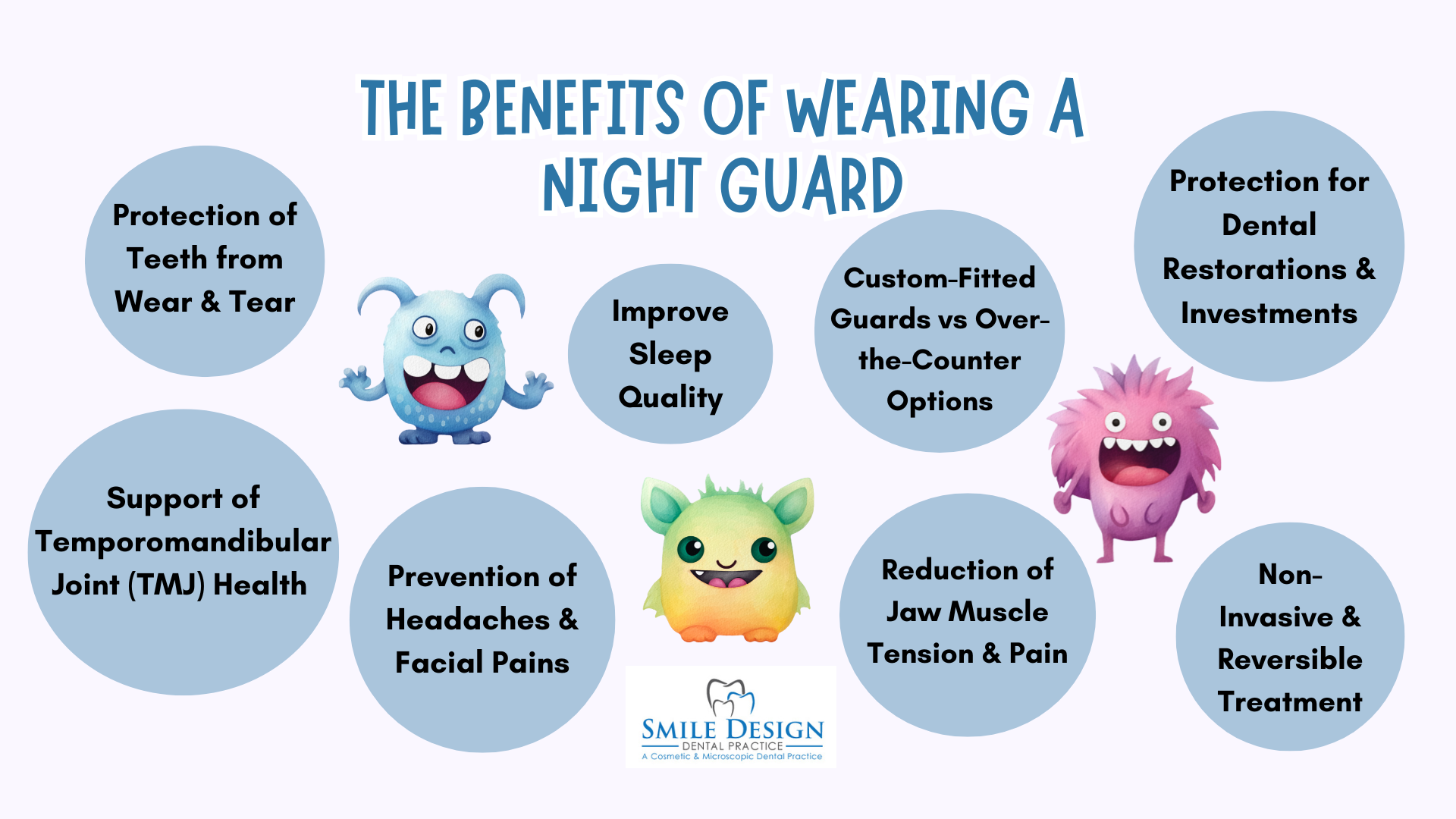
Customised night guard - You want to protect your teeth even after dental restorations to restore the teeth that are flattened due to your teeth grinding habits. You may also want to prevent further damage. We customise night guards for you that fit and protect your teeth from damage during teeth grinding.
- Change of dietary habits - Avoid chewing on hard or chewy food, such as steak and gummy bears, to reduce the stress on the jaw joints.
- Orthodontic treatment - This helps to correct and better align your jaw joints and teeth to ease your teeth-grinding issue.
- Avoid caffeine or alcohol - consumption of caffeine and alcohol at night will affect your sleep quality. It is harder to achieve a deep sleep state.
- Relax before sleep - take a relaxing bath, meditate or read a book to help you wind down and prepare for bed.
Speak to us now to understand the cause(s) of your teeth grinding issue. With a better understanding, we may design multi-prong approaches to solve the issue together with you. Remember, you are not only solving your own teeth grinding issue, but you are also helping your partner to have better sleep quality.