Bleeding and Receding Gums: Small Signs Worth Taking Seriously
Have you ever noticed a little bit of pink in the sink after brushing your teeth?
Perhaps you thought, “I must have brushed too hard.” Or maybe your gums occasionally bleed when you floss, but because there is no pain, you assume it is nothing to worry about.
These small signs are easy to overlook. However, healthy gums generally should not bleed during normal brushing or flossing.

Bleeding gums and receding gums can be early indications that something is changing in your oral health. The challenge is that these changes often develop gradually, sometimes without pain or obvious symptoms.
At Smile Design Dental Practice, we believe that recognising subtle changes early is essential to preserving your natural teeth and maintaining long-term gum health.
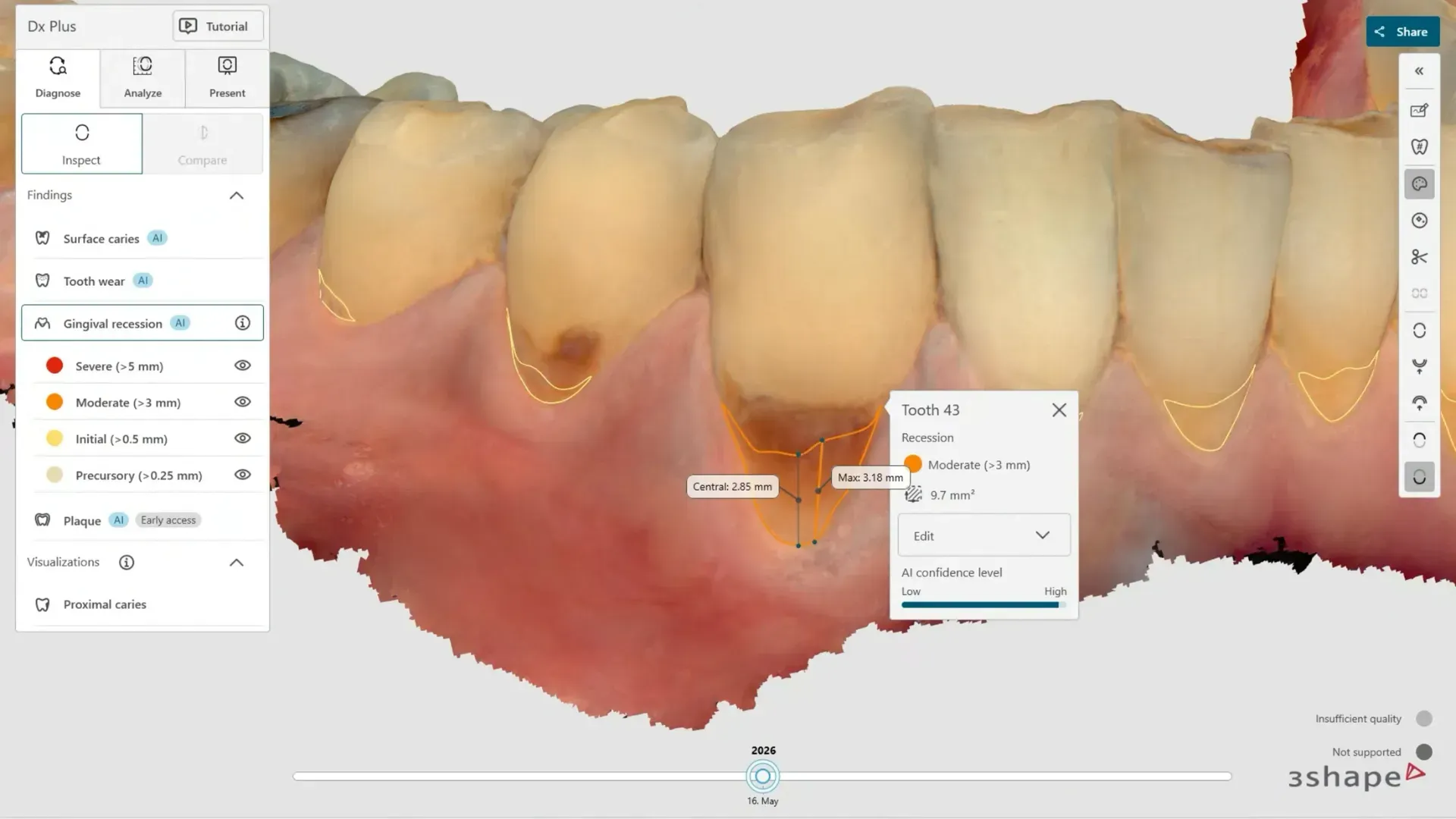
Through comprehensive routine dental examinations and digital monitoring with the 3Shape TRIOS 6 intraoral scanner and Dx Plus AI-assisted software, we aim to make gum health more measurable, understandable, and easier to monitor over time.
From professional cleaning to specialist periodontal care, there are now various approaches to supporting healthy gums. One of these is laser-assisted treatment, which uses focused light energy during selected dental procedures. It is part of the technology available to support personalised dental care.
Bleeding Gums: An Early Warning Sign
Bleeding gums are commonly associated with gingivitis, an early stage of gum disease caused by bacterial plaque accumulating along the gum line.
The encouraging news is that gingivitis is generally reversible when detected and treated early. Professional cleaning and improved oral hygiene can often help restore healthier gums.
However, if inflammation goes unaddressed, it may progress to periodontitis, affecting the tissues and bone that support your teeth.
Not all bleeding is caused by gum disease, so a thorough clinical assessment matters.
The key is not to wait for pain before seeking advice.
Your Gum Health Deserves the Same Attention as Your General Health
Think about your regular medical health screening.
Your blood pressure, cholesterol and blood sugar are all measured and recorded. Your doctor uses those readings to monitor progress over time and recommend early intervention if needed.
Your gum health deserves the same attention.
Rather than assessing your gums only during a single appointment, it is equally important to understand how they change over time.
Are your gums remaining stable? Is inflammation developing? Has your gum line gradually shifted since your previous visit?
Regular examinations and consistent records help us answer these questions, often before you notice any changes yourself.
Receding Gums: Small Changes That Are Difficult to Notice
Unlike bleeding gums, gum recession develops so slowly that you may not even notice it.
It occurs when the gum margin moves away from its original position, exposing more of the tooth and potentially its root.
Common contributing factors include periodontal disease, aggressive brushing, naturally thin gum tissues and certain tooth positions.
As gums recede, exposed root surfaces may become more susceptible to sensitivity, wear and decay.
Unlike early gum inflammation, receded gum tissue generally does not grow back naturally. This makes early detection particularly important.
Traditionally, gum recession has been monitored through clinical measurements and photographs. While these remain essential, identifying small changes consistently between appointments can be challenging.
This is where digital monitoring provides additional value.
Making Gum Health More Measurable with
TRIOS 6 and Dx Plus
We use the 3Shape TRIOS 6 intraoral scanner together with Dx Plus AI-assisted software to support our clinical examinations and long-term gum monitoring.
The scanner captures detailed 3D records of your teeth and visible gum surfaces, while the software helps document and compare gum margin positions over time.
What Does This Mean for You?
During your routine examination, we can capture a digital record of your gums.
At your next appointment, another scan can be taken and compared with your previous record.
- If your gums remain stable, the comparison provides a useful visual reference and reassurance.
- If changes are detected, we can investigate the cause earlier and recommend appropriate preventive care or treatment.
This may involve adjusting your brushing technique, improving plaque control or monitoring a particular area more closely.
AI-assisted digital monitoring also supports more consistent documentation and coordinated treatment planning, particularly for patients undergoing orthodontic, restorative or periodontal care.
Digital monitoring complements rather than replaces clinical periodontal examinations and professional diagnosis.
The real value of this technology is not simply capturing a scan, but understanding what has changed and what those changes mean for your long-term oral health.
Personalised Gum Care: From Early Intervention to Laser and Specialist Treatment
Not every gum concern requires extensive treatment. We start by identifying the underlying cause and recommending care suited to the condition's severity and progression.
For early gum inflammation, professional cleaning, personalised oral hygiene guidance and regular monitoring may be sufficient.
Laser-Assisted Gum Treatment
For certain periodontal conditions, laser therapy can be used as an adjunct to conventional gum therapy.
Depending on the clinical situation and laser system used, laser-assisted procedures may help manage inflamed soft tissues and support periodontal treatment.
Laser treatment does not replace the need for proper plaque and calculus removal, and its additional clinical benefits vary depending on the procedure.
We prioritise treatment methods based on clinical evidence, individual needs, and long-term gum health.

Specialist Periodontal Care
For patients with advanced periodontal disease, significant gum recession, or complex gum-related concerns, we may recommend a specialist periodontal assessment.
A periodontist can provide further evaluation and, where appropriate, advanced treatments such as periodontal surgery, regenerative procedures or gum grafting.
These treatments may help manage complex periodontal conditions, protect vulnerable root surfaces, and support long-term tooth stability.
By combining early detection, appropriate technology, and specialist care when needed, we aim to provide a coordinated, personalised approach to maintaining gum health.
Small Signs Today Can Make a Difference Tomorrow
Bleeding and receding gums aren't necessarily cause for alarm, but they are signs worth taking seriously.
Just as you monitor important indicators of your general health, your gums deserve consistent attention and care.
We combine comprehensive examinations, TRIOS 6 digital monitoring, AI-assisted software and appropriate treatment options, including laser-assisted procedures and specialist periodontal care, to support your long-term gum health.
Our goal is to help you understand your oral health more clearly, recognise changes earlier and preserve your natural teeth for years to come.
Because sometimes, the smallest changes are the ones worth noticing first.
Book your routine dental examination with us now. Together, we can monitor your gum health, address concerns early and help you maintain a healthy smile with greater confidence.
Schedule an appointment with us NOW! Call us at 6463 8588 or WhatsApp to 9815 5336
To serve you better, we are available by
Appointment Only.
Please contact us to schedule an appointment.