Why Magnification Matters?
A Clearer View. A Higher Standard. A Better Smile.
In today’s world of high-definition screens and precision engineering, it may surprise you that dentistry was traditionally performed with the naked eye. While dentists have always aimed for excellence, human vision has limits. And in a field measured in fractions of millimetres, those limits matter.
That’s where magnification comes in.
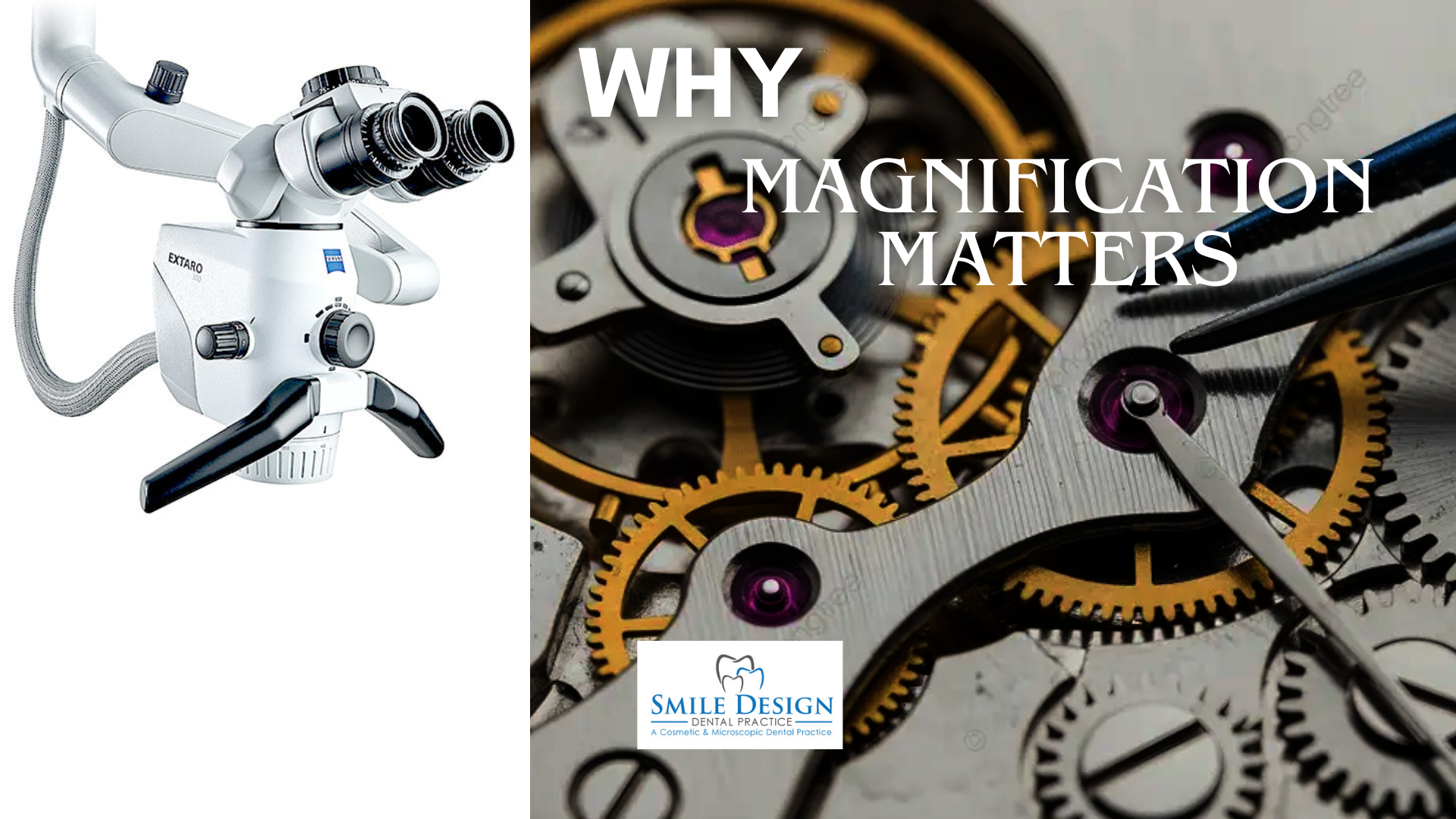
Modern microscopic dentistry uses high-powered magnification tools, such as dental loupes and advanced operating microscopes, including the ZEISS EXTARO 300 by Carl Zeiss AG. These technologies allow dentists to see details up to 20 times larger than the naked eye can—transforming the way dentistry is performed.
But what does that mean for you as a patient?
Let’s break it down.
1. Dentistry Is Micro-Surgery
Your tooth structure is incredibly delicate. Enamel, dentine, and pulp exist in tiny layers measured in microns. When decay begins, it starts small—often invisible to the naked eye.
Magnification allows dentists to:
- Detect early decay before it becomes painful
- Identify hairline cracks
- See tiny fractures in old fillings
- Locate hidden canals during root canal treatment
When we see better, we treat earlier. And earlier treatment means smaller procedures.
2. Less Drilling. More Preservation.
One of the core principles of microscopic dentistry is ultra-conservative treatment.
Without magnification, distinguishing healthy from infected tooth structure can be difficult. To ensure all decay is removed, dentists may unintentionally remove more healthy structure than necessary.
With magnification:
- We remove only what is damaged
- We preserve healthy enamel
- We reduce the size of fillings
- We strengthen the long-term survival of the tooth
The result? Stronger teeth that last longer.
3. Higher Precision = Better Fit
Whether placing a filling, crown, or veneer, precision determines longevity.
Margins—the edges where restorations meet natural teeth—must fit seamlessly. Even microscopic gaps can allow bacteria to enter, leading to leakage or recurrent decay.
Magnification enhances:
Accuracy of preparation
- Cleanliness of margins
- Adhesive bonding quality
- Aesthetic detailing
In cosmetic dentistry, it also ensures natural texture and symmetry that blend beautifully with your smile.
4. Improved Root Canal Success
Root canal systems are complex. Some teeth have accessory canals thinner than a strand of hair.
Using a dental operating microscope allows the dentist to:
- Locate hidden canals
- Remove broken instruments safely
- Treat complex anatomy
- Reduce retreatment rates
This level of precision dramatically improves long-term outcomes.
5. Better Documentation & Transparency
Modern microscopes often integrate high-definition video and photography.
This allows us to:
Show patients exactly what we see
- Document cracks or decay clearly
- Educate visually
- Build trust through transparency
When patients understand their condition visually, decision-making becomes easier and more confident.
6. Ergonomics for Longevity
There’s another hidden benefit: the dentist’s health.
Microscopes allow clinicians to sit upright with proper posture rather than bending over patients for hours. This reduces neck and back strain, allowing experienced dentists to practice at a high level for many years.
A comfortable dentist is a focused dentist.
7. Why Isn’t Every Clinic Using It?
Microscopic dentistry requires:
- Significant financial investment
- Advanced training
- Longer treatment time
- A commitment to meticulous standards
Not every clinic chooses this path because it demands precision, patience, and a philosophy of excellence.
It’s not just equipment. It’s a mindset.
8. The Branding of Precision Dentistry
When a clinic embraces magnification, it signals something deeper:
- Attention to detail
- Commitment to preservation
- Respect for biology
- Long-term thinking
Microscopic dentistry is not about doing more.
It’s about doing less — better.
In a world where speed is often prioritised, magnification represents care.
What This Means for You
When you choose a dentist who works under magnification, you are choosing:
- Early detection
- Minimal intervention
- Greater accuracy
- Stronger long-term outcomes
- Transparent communication
You may not see the microscope during your treatment, but its impact is built into every millimetre of care.
The Future of Dentistry Is Clear
High-definition imaging changed photography.
Precision robotics changed surgery.
Magnification is transforming dentistry.
Seeing more is not about complexity.
It’s about clarity.
And clarity builds confidence.
Schedule an appointment with us NOW! Call us at 6463 8588 or WhatsApp to 9815 5336
To serve you better, we are available by Appointment Only.
Please contact us to schedule an appointment.